
Why learn knots
A tarp shelter, a clothesline, securing a load, hanging food, lifting, towing — you'll use rope constantly in an outage or off-grid. Learn these six until you can tie them without thinking, even in the dark.
Practice tip: keep a 3-foot piece of rope by the couch, and tie each knot five times while you watch TV.
The six knots
| Knot | Use it to | Notes |
|---|---|---|
| Bowline | make a fixed loop that won't slip or tighten — around a tree, a person, a post | "King of knots." Unties easily after a heavy load. |
| Clove hitch | tie a rope to a pole or post quickly | fast to tie and adjust; can slip if the load shifts — add half hitches |
| Taut-line hitch | make an adjustable loop for tent and tarp guy lines | slides to tighten, holds under tension |
| Two half hitches | tie a rope to a ring, post or tree | simple and secure |
| Sheet bend | join two ropes, even of different thickness | better than a square knot for joining |
| Trucker's hitch | tighten a line hard — loads, ridge lines, clotheslines | gives about a 3:1 pulling advantage |
Tying a bowline
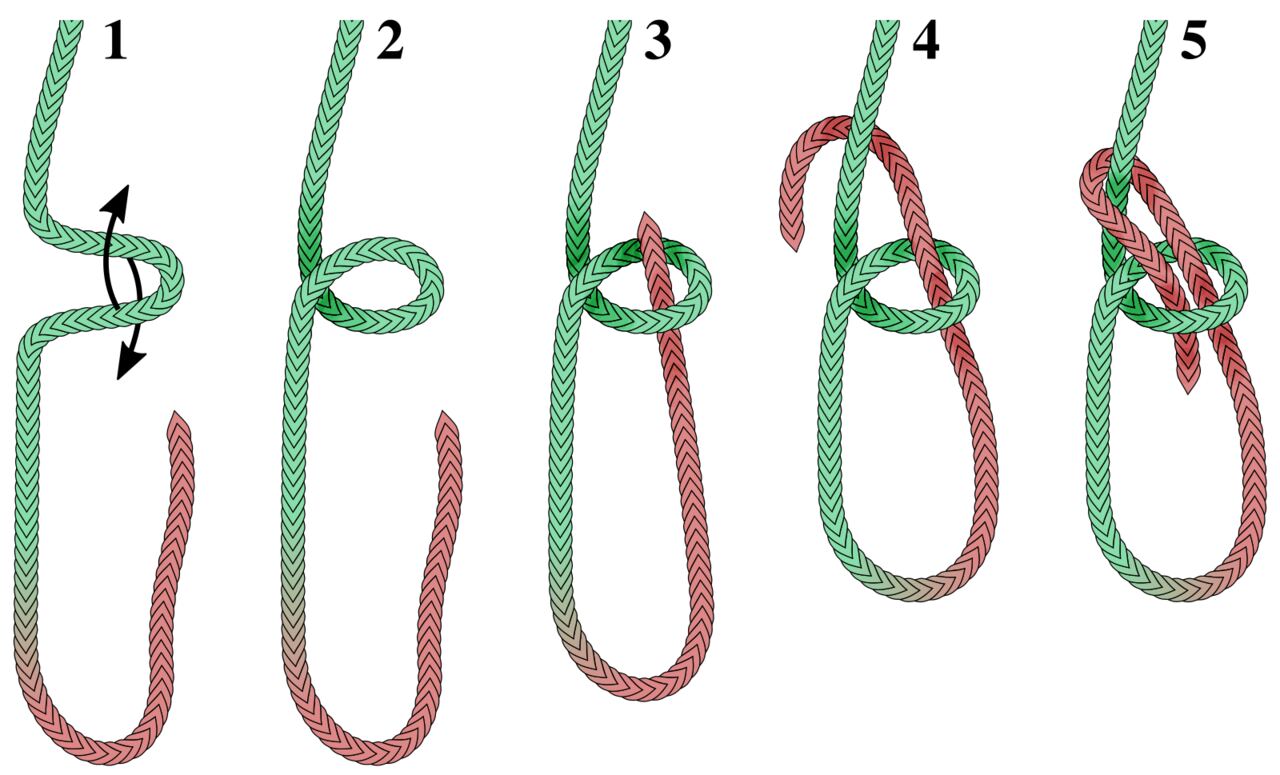

- Make a small overhand loop in the standing part of the rope (the "rabbit hole").
- Bring the working end up through the loop ("the rabbit comes out of the hole").
- Pass it around behind the standing part ("around the tree").
- Bring it back down through the small loop ("back down the hole").
- Hold the working end against the loop and pull the standing part to tighten. Leave a tail at least 10 rope-widths long.
Rope basics
- Paracord (550 cord): strong, light, lots of uses. Its inner strands can be pulled out for thread or fishing line.
- Rope for loads: use rated rope and straps for anything heavy. Never use household or paracord for climbing, lifting people, or towing.
- Keep rope dry and coiled, and burn (melt) the ends of synthetic rope so it doesn't fray.
For step-by-step animations of hundreds of knots, see Animated Knots (needs internet).
Sources: ATP 3-50.21 Survival (appendix on knots) · Animated Knots