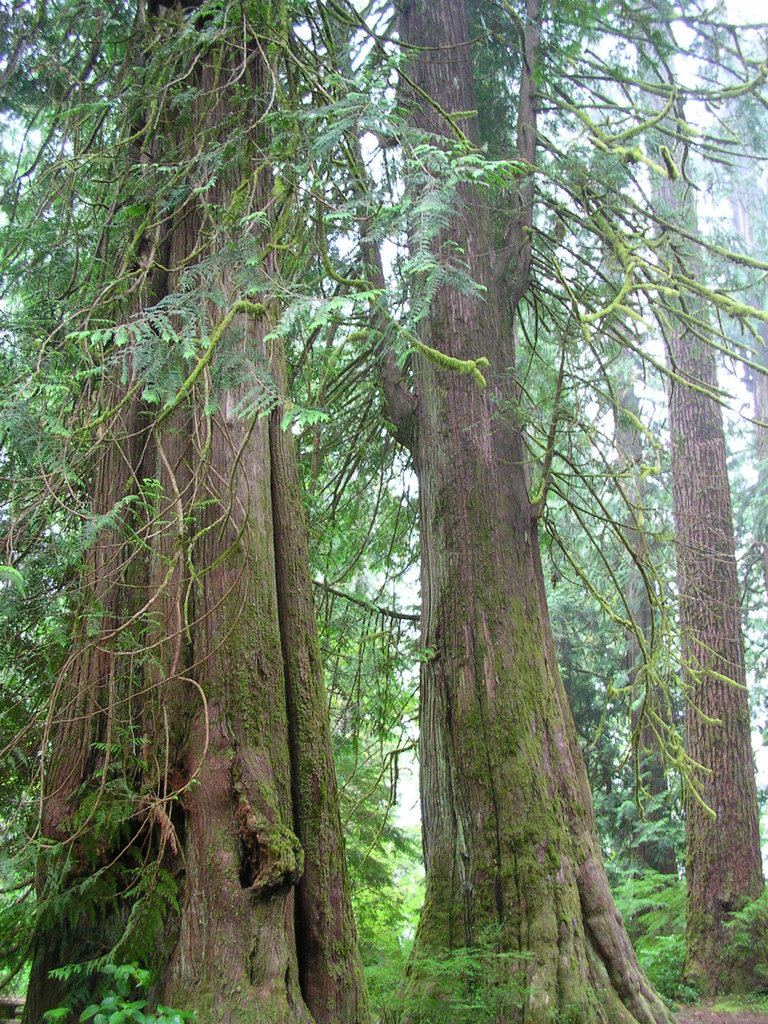
Western redcedar
Thuja plicata · Tree
📍 972 verified iNaturalist sightings in eastern WA & north Idaho.
⚠️ Cautions
Leaf oil contains thujone—do not drink strong teas or use in pregnancy.
How to identify
Huge tree with flat scale-like sprays and fibrous reddish bark; moist north Idaho forests.
Traditional uses
Bark and leaves used traditionally for coughs, colds, and as a disinfecting wash.
More: iNaturalist · Wikipedia
Background
Thuja plicata is a large coniferous tree in the cypress family, Cupressaceae, native to the Pacific Northwest of North America. Its common name is western redcedar, although it is not a true cedar. It is often spelled western red cedar in the Pacific Northwest, and is sometimes known as pacific red cedar, giant arborvitae, western arborvitae, just cedar, giant cedar, or shinglewood. T. plicata is the largest species in the genus Thuja, growing up to 70 metres (230 ft) tall and 7 m (23 ft) in diameter. It mostly grows in areas that experience a mild climate with plentiful rainfall, although it is sometimes present in drier areas on sites where water is available year-round, such as wet valley bottoms and mountain streamsides. The species is shade-tolerant and able to establish in forest understories and is thus considered a climax species. It is a very long-lived tree, with some specimens reaching ages of well over 1,000 years.
Indigenous peoples of the Pacific Northwest use the wood of this species for many purposes, such as building canoes, totem poles, and tools. The bark is harvested by indigenous peoples and processed into a fiber, which they use to make items such as rope, baskets, clothing, and rain hats. Because of its wide range of uses, the species is of great cultural importance to these people. Western redcedar wood is aromatic and rot-resistant and is used for applications such as the construction of shingles and siding. It has been introduced to cool temperate areas in other parts of the world, such as Northern Europe and New Zealand.
From Wikipedia, Thuja plicata, under CC BY-SA 4.0.