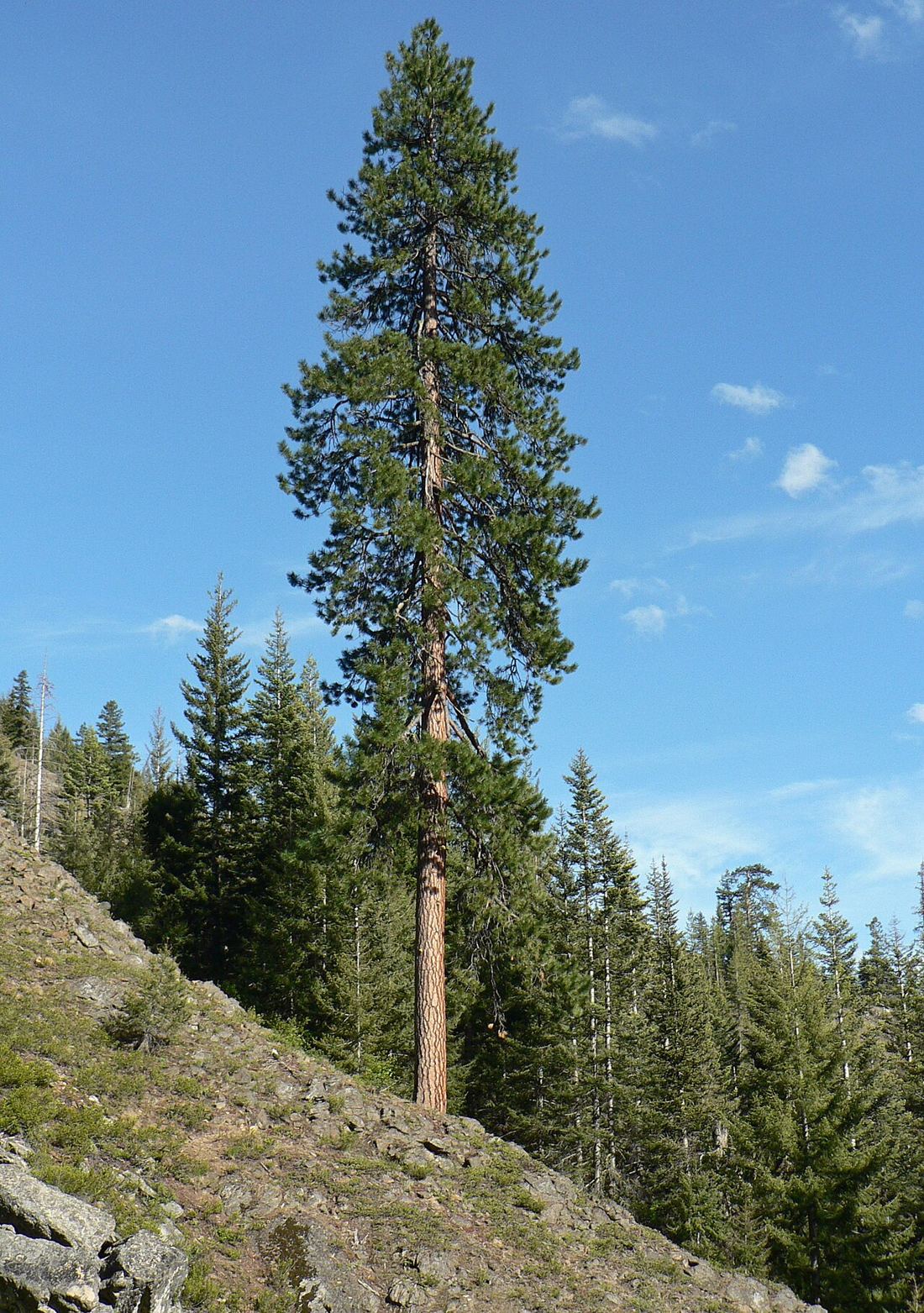
Ponderosa pine
Pinus ponderosa · Tree
📍 7,080 verified iNaturalist sightings in eastern WA & north Idaho.
⚠️ Danger
Needles can cause abortion in cattle.
How to identify
Large pine with orange 'puzzle-piece' bark that smells like vanilla; needles in 3s, 5–10 in long.
Food & traditional uses
Inner bark eaten in spring; seeds edible; pitch used as a salve for sores.
More: iNaturalist · Wikipedia
Background
Pinus ponderosa, commonly known as the ponderosa pine or western yellow pine, is a very large pine tree species of variable habitat native to mountainous regions of western North America. It is the most widely distributed pine species in North America.
Pinus ponderosa grows in various erect forms in 16 western U.S. states as well as British Columbia in Canada and has been introduced in temperate regions of Europe and in New Zealand. It was first documented in modern science in 1826 in eastern Washington near present-day Spokane (of which it is the official city tree). On that occasion, David Douglas misidentified it as Pinus resinosa (red pine). In 1829, Douglas concluded that he had a new pine among his specimens and coined the name Pinus ponderosa for its heavy wood. In 1836, it was formally named and described by Charles Lawson, a Scottish nurseryman. It was adopted as the official state tree of Montana in 1949.
Other vernacular names that have been used for the species are "bull pine" and "blackjack pine", but these are general woodsmans terms applied to growth stages of several different pines, rather than specific to Pinus ponderosa.
From Wikipedia, Pinus ponderosa, under CC BY-SA 4.0.
