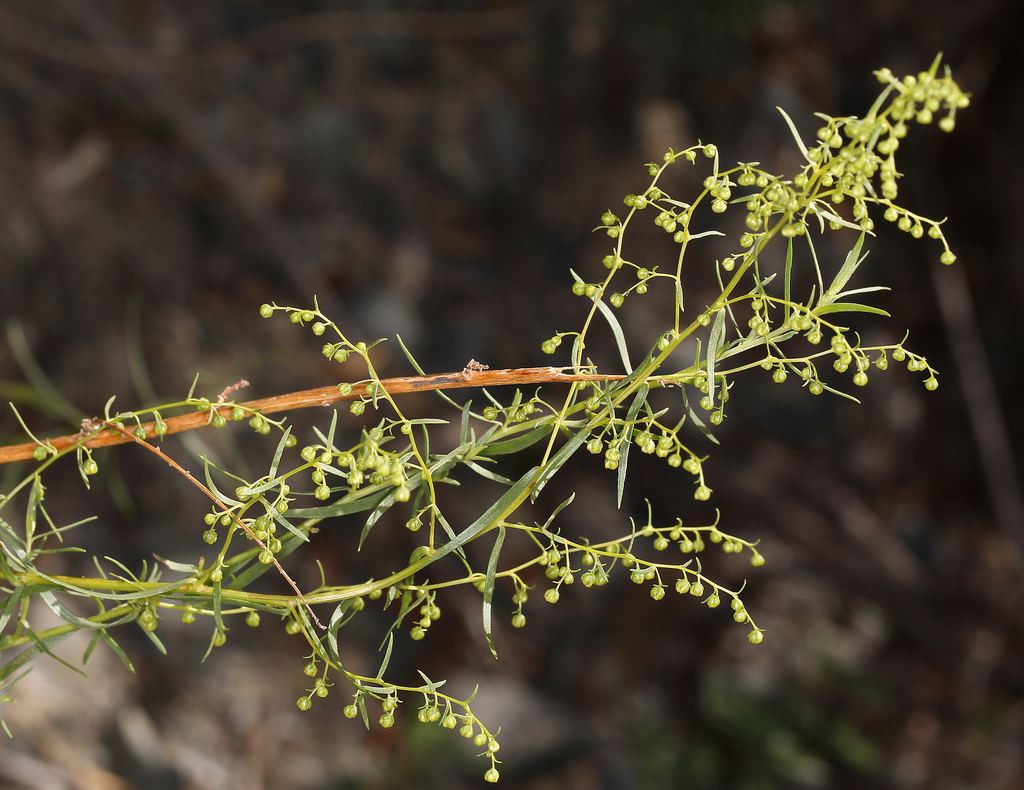
Wild tarragon
Artemisia dracunculus · Wildflower / herb
📍 24 verified iNaturalist sightings in eastern WA & north Idaho.
⚠️ Cautions
Avoid in pregnancy.
How to identify
Upright green herb with narrow leaves; mild tarragon smell.
Food & traditional uses
Leaves as seasoning; tea traditionally for digestion.
More: iNaturalist · Wikipedia
Background
Tarragon (Artemisia dracunculus), also known as estragon, is a species of perennial herb in the family Asteraceae. It is widespread in the wild across much of Eurasia and North America and is cultivated for culinary and medicinal purposes.
One subspecies, Artemisia dracunculus var. sativa, is cultivated to use the leaves as an aromatic culinary herb. In some other subspecies, the characteristic aroma is largely absent. Informal names for distinguishing the variations include "French tarragon" (best for culinary use) and "Russian tarragon".
Tarragon grows to 120–150 centimetres (4–5 feet) tall, with slender branches. The leaves are lanceolate, 2–8 cm (1–3 in) long and 2–10 mm (1⁄8–3⁄8 in) broad, glossy green, with an entire margin. The flowers are produced in small capitula 2–4 mm (1⁄16–3⁄16 in) diameter, each capitulum containing up to 40 yellow or greenish-yellow florets. French tarragon, however, seldom produces any flowers (or seeds). Some tarragon plants produce seeds that are generally sterile. Others produce viable seeds. Tarragon has rhizomatous roots that it uses to spread and readily reproduces.
From Wikipedia, Tarragon, under CC BY-SA 4.0.